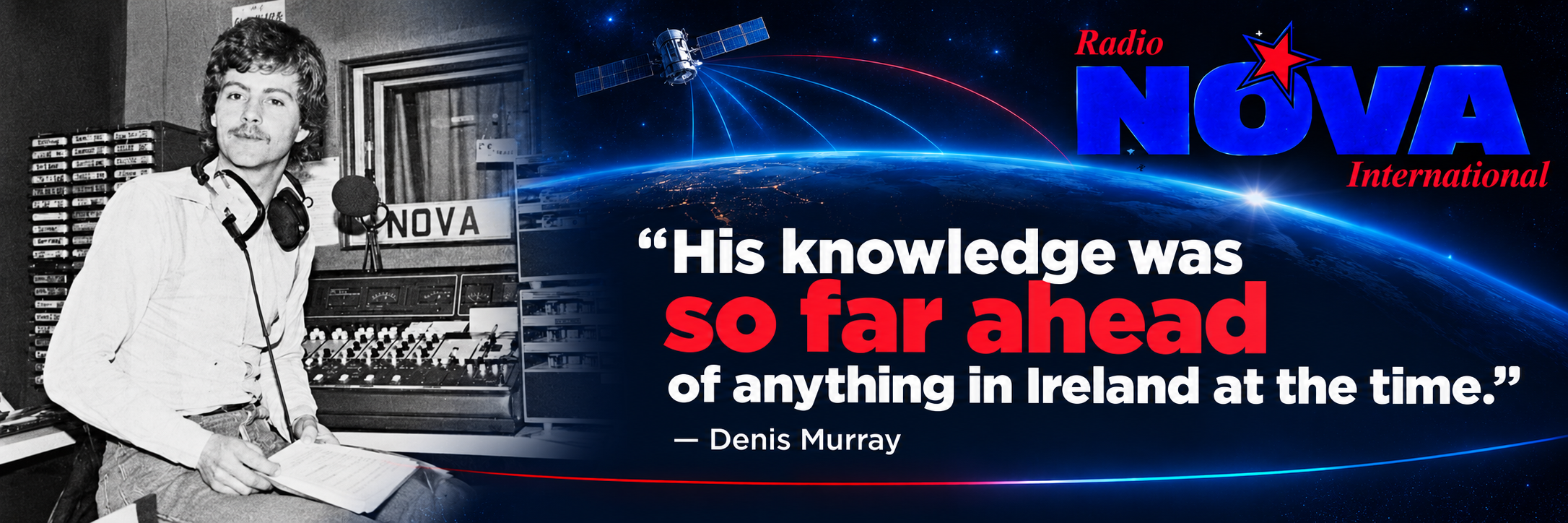
On April 29th 1988, the third incarnation of Radio Nova appeared as a test broadcast on Intelsat VA F11. The station, whose beating heart for so long resided in Dublin, was now based in England and available all over Europe. Unfortunately, the only way Dubliners could hear it was via a huge dish that not only cost the earth but was similar in size.
Chris Cary’s was the first voice to be heard on Radio Nova International and a familiar name to Dublin listeners, Tim Kelly, hosted the first show. Other familiar names which would appear over the following days were Liam Quigley, Declan Meehan, Cassidy Jones.
Nova launched, as planned, on May 1st and then was officially launched on May 4th by Timothy Renton MP, the Minister of State for Broadcasting. This time around it was totally legit, operating under the auspices of the Cable Authority.
The transmissions from Nova's studios in Surrey were micro-linked across to the Telecom Tower, which was located in the West End of London. From there, they were beamed to British Telecom's Teleport in Docklands, also in London, where the signal was uplinked to the Intelsat VA F11 satellite, situated in geo-stationary orbit 26,000 miles above the planet. The satellite returned the signal to earth and was converted via a compatible satellite dish and receiver for domestic reception, or redistrubuted via cable or relayed via FM/MW. And all this took a fraction of a second!
The schedule was compiled using a computer package, with each hour's output timed to the nearest second. The DJ played a track by keying into a computer terminal and the selected track automatically played from a bank of 20 multiple CD players, each containing 6 compact discs. This gave instant access to around 1,500 tracks. Any track not yet available on CD was copied onto cartridges to be played by the system.
Advertisers are notoriously nervous of anything new and were slow to react to the new method of delivery, despite the familiarity of it being a CHR station. Plans began to be put in place to increase the station’s visibility to potential audiences. On May 26th a new nighttime sustaining service was announced.
Nova Comes Out At Night
Using the name ‘The Nova Night Network’, the new service would be made available between 7pm and 6am to radio stations operating on FM, allowing them to offer programming in what would normally be their downtime.
A few stations signed up straight away and at 9pm on July 1st, for the first time in Britain, a satellite radio station was broadcast terrestrially via a local independent radio station. The station in question, Northsound Radio, was based in Aberdeen in Scotland and it carried the Nova Night Network six nights a week.
In Ireland, Coast Hot Hits in Galway were already carrying the service, along with Sound Channel in Limerick.
Andy Green, ABC Radio Waterford
We installed a big 1.8m satellite dish on the ABC radio studio roof to pick it up to supply overnight programming. He operated a contra deal whereby we got a free sustaining service and he sold ads. Nova would mention each station that carried it every so often
By July, Radio Nova International was being relayed full time via one of Liberty 104’s frequencies in Dublin. Local news and advertisements were inserted by Liberty at various times.
It was also being relayed full time on 94.9MHz by Paul Vincent, whose Southside Radio had just closed.
Simon Maher: I remember asking Paul Vincent about the 94.9 relay and he mentioned that Cary wanted to keep a low pirate profile when launching Nova satellite but later discovered that he needed Dublin revenue so approached Southside at a time that suited them financially!
Change Ahead Back in Ireland
In June, the government had finally managed to get their Broadcasting Bill through all stages to become law. At the end of the year all pirates would be required to vacate the airwaves, and at the start of 1989 a process would begin to start licensing new local services across the country, along with one national station to cover the country.
On December 31st, the satellite relay was switched off at 1pm in Dublin and with Radio Nova confirmed as one of four companies who had expressed an interest in applying for the new national service, Chris Cary and Sybil Fennell spent the holiday period preparing a presentation which would be heard – along with other applicants – by the newly formed Independent Radio and Television Commission on January 12th.
Chris Cary indicated that he would uproot Radio Nova from Surrey back to Ireland should they be successful.
Old enemies were lurking, ready to pounce. The NUJ wasted no time in stating their opposition to Cary's bid, saying it would be an “affront” if his application was successful.