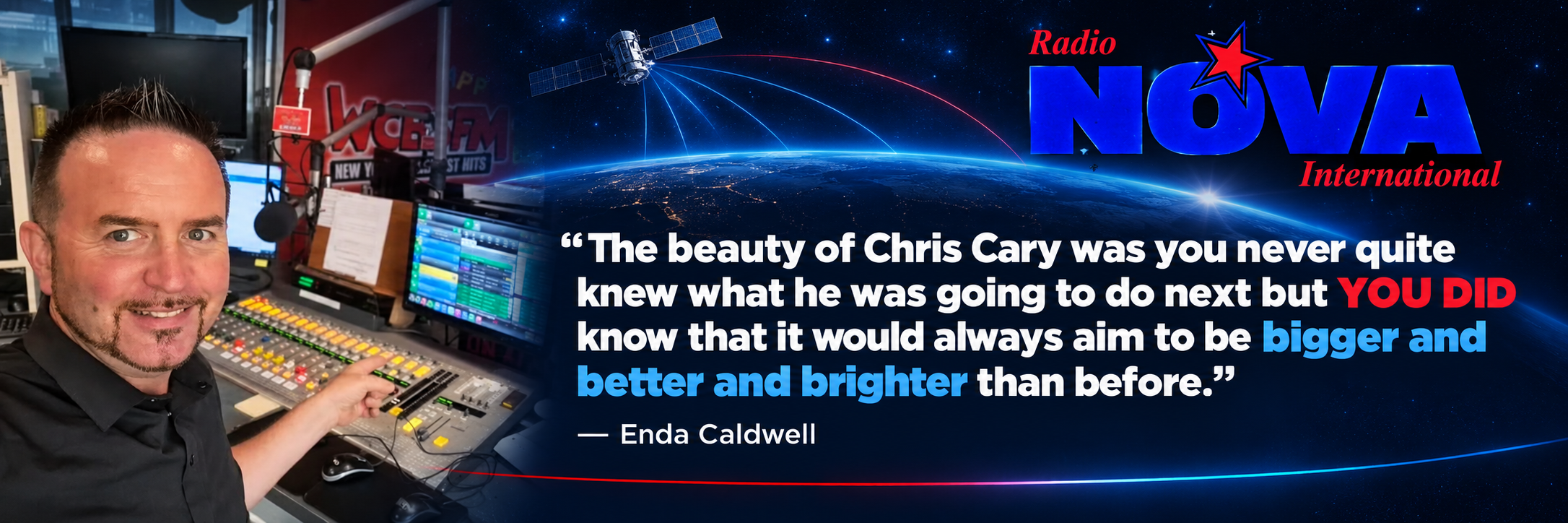
The sudden, publicly inexplicable, loss of Energy 103 left a definite void in the Dublin radio landscape. For the first time in seven years Chris Cary, or a station he’d played a big part in establishing, was not involved. This was further exacerbated when Q102 joined Sunshine 101 in running the Hot Hits format – a format which sucked the listener in to unimaginable new dimensions of personality-free radio. Despite being clutter free (in name for the most part) Cary’s stations were always filled with personality presenters with whom the listener could feel a connection.
So, with legislation to introduce new local independent stations extremely imminent, why did Chris Cary pick March 11th to suddenly pull the plug on Energy 103?
Anybody paying attention to the newspapers at the time of the Nova/Energy merger in November 1987 would have been given a major clue. At that time Cary revealed plans to launch Radio Nova as a satellite station, boasting that this time the authorities wouldn’t be able to shut him down.
So why did he launch Radio Nova terrestrially in Dublin at that time and then merge it with Energy, which was ticking along quite nicely at that point? Obviously, the ultimate plan was to apply for a licence, but where did the satellite station fit in?
Many of those answers would be revealed over the following months but one wonders did he plan to launch the satellite service and have it enhance Nova Power 103 in some way?
We will never know.
The simplest answer might be the obvious - he had not yet received permission to go the satellite route and was making sure something was in place on the ground - in a manner of speaking - in light of the impending legislation.
If the Nova receiver had not objected to the use of the Radio Nova name a few weeks following the merge we may have found out.
Radio of the Future
Chris Cary was an innovative man, always light years ahead of others not just in having ideas, but putting them into practice. His first inkling that a satellite radio service could be a station of the future, with developmental possibilities that weren’t possible via a local FM service, came at the start of 1987. At that point he applied for transponder space on one of the new satellite media services whose main purpose was to feed television pictures to cable headends all over Europe. Domestic satellite reception was at this stage the preserve of the enthusiast with deep pockets.
Cable TV was a huge industry in most European countries, allowing access as it did to television signals from neighbouring countries without the need of a huge antenna.
In Ireland, of course, the lure of receiving the British channels meant that there was almost saturation subscription whereever the cable for cable companies bypassed. Most cable companies also carried radio services and it was this that Cary hoped to tap into. The one possible downfall in that plan was that the major cable service in Dublin was ran by RTÉ – the old enemy.
Energy 103 had become a shadow of itself as 1988 began. The station never really recovered from the confusion caused by the merge with Radio Nova. It appeared, too, that Cary had very much lost interest when he was prevented from using the Nova name locally, the irony being that a court later decided that the receiver had no legal case in stopping the use of the name.
Timing is everything though. In March, Cary finally received the go-ahead to utilise transponder space and he immediately shut down Energy 103, shipping much of the equipment across to England and selling off the rest of the station’s assets to Q102.
Lift Off
As Energy was consigned to the radio annals, in Camberley, Surrey, work had already began on new, high-tech studios on the upper floor of a factory unit, which was also home to Cary's electronics company. The aim was to launch on May 1st and become the first commercial radio station based in Britain to broadcast over satellite.
The following is the text of a Press Release from April 19th 1988:-
Radio Nova International – Britain’s first-ever commercial radio station to broadcast via satellite – will launch on May 1st.
The station will broadcast from a hi-tech studio complex located in Camberley, Surrey, which incorporates state-of-the-art equipment (and thinking….).
Radio Nova International will play much more music, less talk (24 hours per day of the hottest hits) available in stereo to audiences throughout Europe. The potential European cable audience exceeds 30 million.
Nova also hopes to be re-broadcast in most major markets in Europe via terrestrial radio stations.
Target age group 15-39.
Radio Nova International is the brainchild of Chris Cary – a name synonymous with innovations in the broadcast field – whose career to date includes the position of station manager with Radio Luxembourg. Chris Cary also founded and ran the hugely successful Radio Nova in Ireland.
Radio Nova International will broadcast via Intelsat VA F11 with programmes beamed from transponder 63 on sub-carrier frequencies 7.38 and 7.56MHz.
Radio Nova International will make extensive use of computerised music programming – an entire software package has been commissioned to format the station’s music output. Music will be played on compact disc.
Nova brings together old friends and new faces in a line-up of international on-air talent. Radio Nova International announced today that the following well-known names will be joining their DJ line-up from the launch date on May 1st:
Tony Blackburn
Paul Burnett
Timmy Mallett
Mark Wesley
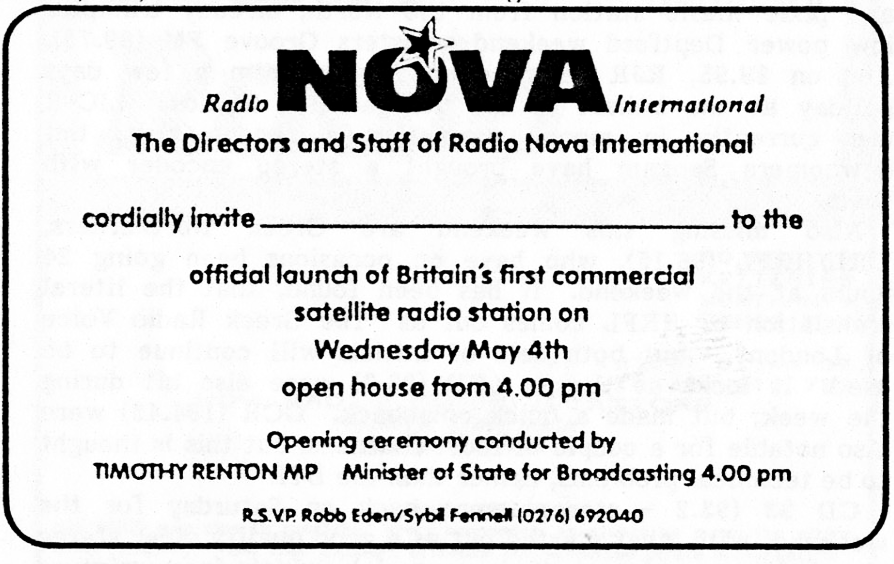
Radio Nova International will be officially opened by Timothy Renton MP, Minister of State for Broadcasting, on Wednesday 4th May 1988.