THE FRC IRELAND SECTION: Intro - FRC Newsletter - FRC Sounds Alternative - 1978 in radio - Print era ends - FRC on the radio
The Free Radio Campaign Ireland by Kieran Murray
Welcome to the history of The Free Radio Campaign Ireland including the radio programmes ‘The FRC Ireland Show’ and ‘The Free Radio Show’ plus the publications ‘Newsletter’ and ‘Sounds Alternative’. I am delighted to be able to provide this contribution – telling you my story and highlighting the history and background to these events.
So how did I get in on this? How did all this come about?
1970: FRC Ireland – The Idea
It all started around 1970. I was a radio-mad teenager and enjoyed listening to stations like Radio Luxembourg (‘208’) and the offshore pirate radio stations Radio Caroline, Radio Mi Amigo and Radio Northsea International. The offshore radio stations broadcast from ships, anchored in international waters, just off the coast of the Netherlands. They operated outside the law with no government restrictions. They played pop music and for me, they were the essence of what it was to listen to ‘Free Radio’. The idea was getting set…
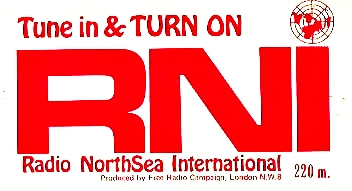
One of the programmes that was broadcast on RNI was called ‘Radio Northsea Goes DX’ and it was presented by A.J. Beirens. His show was transmitted on the short wave service of RNI and, as it was on short wave, I could hear this clearly during daytime hours. The weekly show featured news clips about radio stations, reception reports, frequencies and the concept of QSL Cards (this was a postcard that was usually sent out by a radio station, in reply to a letter received from a listener in some far-away country and it verified/confirmed that the programme details listed in that report were in fact correct).
The show’s theme tune was the same as RNI’s theme tune: .
The Radio Northsea Goes DX programme continued every weekend until RNI eventually closed down on 31st August 1974, due to the passing of the Dutch Marine Anti-Pirate law, which came into force the following day.
1976: FRC Ireland – Gets Started
As a teenager, growing up in south Dublin in Ireland, I became fascinated with the idea of a radio show that featured news, reception reports and general information about radio stations around the world.
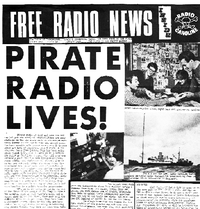
I was also drawn to the idea of a printed media that also covered that same subject.
The idea was set…
So in 1976, while still in my teens, I became aware of an organisation in the UK called The Free Radio Campaign. They produced stickers,
posters and a publication called ‘Newscaster’ with news promoting Radio Caroline and also land-based pirate radio stations. They also
organised rallies – encouraging people to show their support for RNI, Radio Veronica and Radio Caroline, in advance of the Dutch Marine
Anti-Pirate Law (1974). They distributed stickers and posters in support of Free Radio.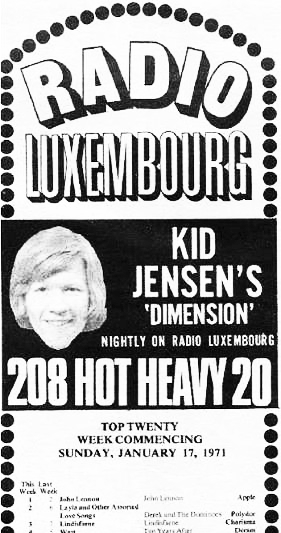
hormones got up to under the
bedsheets in the 70s
You must remember at that point in time, radio stations were heavily regulated and commercial radio was banned. The only listening choice was state broadcasters Radio Éireann (Ireland) and the BBC (UK). All radio broadcasting was in state control and most countries across Europe had severe restrictions on what could, and could not, be broadcast (with the exception of the offshore stations and of course, Radio Luxembourg 208).
The FRC set out to try to change all that and grew to include: FRC – UK, FRC – Germany, FRC – France, FRC – Denmark and FRC – Holland.
Each of the groups would produce their own publications and post them out to their individual subscribers. Plus, they also forwarded/swapped their publication with each of the editors of the other groups, every month. So everyone all received a copy of each other’s publication.
FRC – Ireland was missing from that list, so I offered the group to put this right and to be the main point of contact for a newly formed FRC – Ireland. They all agreed. Early 1976, I wrote to the various FRC clubs in Europe and asked them to print the fact that I was going ahead with an Irish version of this club and intended to produce a publication. I got very positive responses and they were happy to take me on board and help out.
The address for FRC – Ireland was: 53 Charleston Road, Ranelagh, Dublin 6, Ireland. This is where I lived with my parents, in the middle flat of that large house.
Next: An idea comes to life - The various FRC publications.
Back: Introduction