Belfast radio station
2BE
The Belfast station of the British Broadcasting Company
About
2BE was the first radio station to broadcast in Northern Ireland. Launched by the British Broadcasting Company (the precursor to today’s Corporation), the station started transmissions in Belfast on September 15th 1924. 2BE were the call letters chosen for the Belfast station.
At the time, 2BE was a marvel of mid-1920s engineering. The physical setup was split between a makeshift studio and a heavy-duty industrial transmitter.
The Studio was located in a converted linen warehouse at 31 Linenhall Street, Belfast. The walls were heavily draped in thick grey blankets to deaden the acoustics—a primitive but effective form of soundproofing.
The transmitter was 1.5-kilowatt, built by the Marconi Company, situated at the Belfast Corporation electricity works on East Bridge Street.
Suspended between two massive 200-foot steel masts, dominating the Belfast skyline, was the aerial. Broadcasting on 435 metres (approximately 989 kHz on the medium wave band).
The First Broadcast
At 7:30pm on September 15th 1924, the first transmission for 2BE commenced. The opening broadcast was a mix of civic formality and classical entertainment. 2BE's first director and announcer was Tyrone Guthrie, a young man of 23 who would later achieve worldwide fame as a theatrical director.
After a brief silence, Guthrie introduced the station under its official call sign: "This is 2BE, the Belfast station of the British Broadcasting Company.
He introduced the first programme; "The Official Opening", a broadcast of a number of speeches by local notables, starting with the Lord Mayor of Belfast, Sir William Turner. Turner predicted that radio would become "a great factor in our civic life."
Next to entertain the listeners was "The Musical Programme", which ran until the station closed down at 10pm. Performers had to stand close to a single, massive microphone. The Belfast Radio Orchestra, conducted by E. Godfrey Brown, played selections from Bizet's Carmen.
The night's broadcast concluded with a live orchestral performance of 'God Save the King' before Guthrie signed off with the first ever 2BE weather report and local news bulletin. He then wished listeners a formal "Goodnight" and silenced the transmitter on East Bridge Street.
Early Challenges
The high cost of receiving equipment meant that, initially, radio was a hobby of the affluent. In addition, listeners were required to purchase a 10-shilling wireless licence. Detecting "pirate" listeners who operated homemade crystal sets without a licence became an early priority for the Post Office. Most working-class listeners used simple crystal detectors with headphones. Because these sets had no amplification, reception was limited to a radius of about 15 to 20 miles around Belfast. Those in rural areas of Northern Ireland required expensive, multi-valve receivers powered by heavy batteries.
Guthrie and his team struggled to balance the BBC’s London-centric programming with the demands of the local populace. The station eventually found its footing by broadcasting local agricultural reports, industrial news for shipbuilders, and regional drama.
Progression
2BE became part of the newly established British Broadcasting Corporation in 1927 and its services continued to grow. This year also saw the station's first outside broadcast from the Ulster Grand Prix motorcycle races and the start of BBC support for charitable appeals – both of which continue today.
On January 6th 1935 the service was renamed as Northern Ireland Regional Programme and on March 20th 1936 the Belfast transmitter was replaced by a more powerful transmitter broadcasting from Lisnagarvey on 307m (977 kHz). This brought BBC radio services to audiences across Northern Ireland for the first time and was accompanied by a specially commissioned series of programmes and features.
Broadcasting House
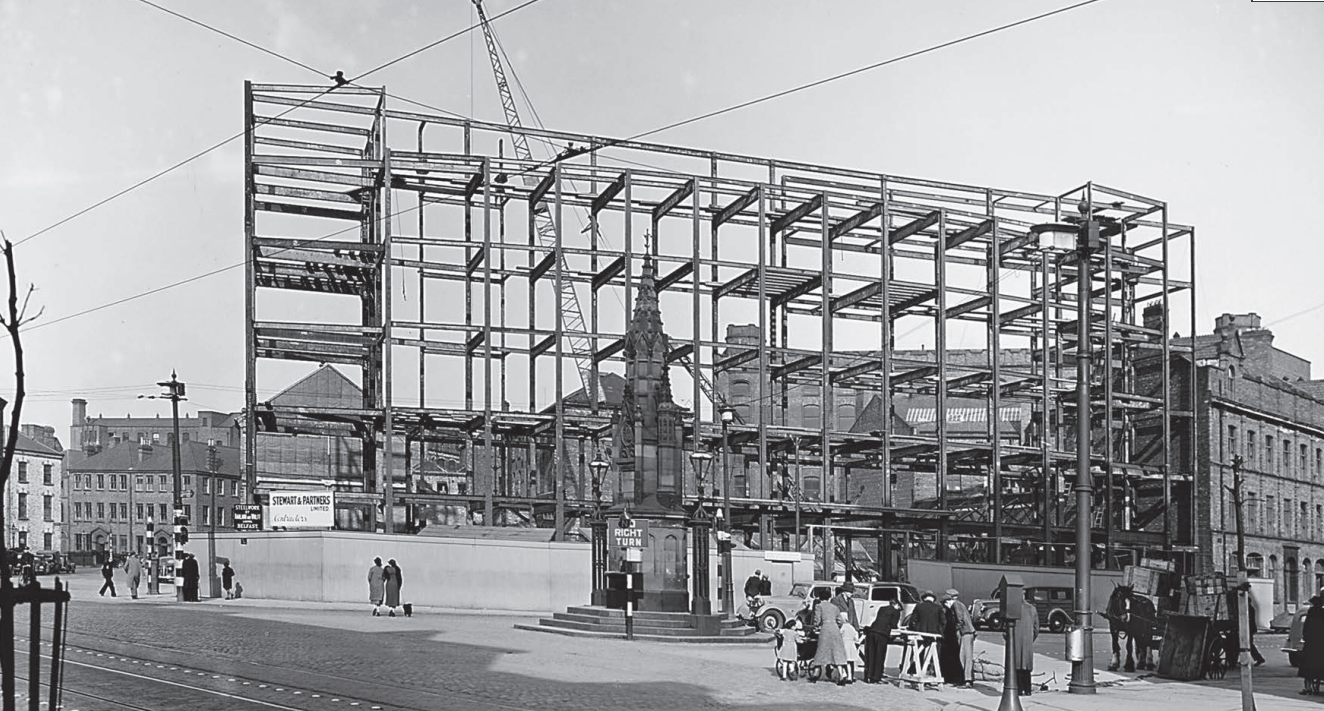
By the mid-1930s the limitations of the BBC's studios at Linenhall Street had become apparent, and preparations began to create a new home for local broadcasting in Northern Ireland. By mid-1937 it had been confirmed that the BBC had acquired a city centre site and that it intended construct a 'Broadcasting House' in its main characteristics similar to the headquarters of the Corporation in London'. Substantive building work began in 1939 and continued despite the outbreak of World War II. It was completed in 1941 with regular programming beginning following the end of the war in 1945.
2BE was renamed BBC Northern Ireland Home Service in 1945. It formed part of the North Regional Service due to a shortage of frequencies – it was on 261m. It became an opt out in its own right in January 1963 when it operated on its own frequency of 224m (1340kHz).
Following the massive revamp by the BBC in 1967, the broader BBC Home Service brand was renamed BBC Radio 4, though regional opt-outs maintained distinct local identities for several more years, including BBC Radio 4 Northern Ireland.
Northern Ireland eventually got its own dedicated radio station on January 1st 1975 in the form of BBC Radio Ulster.
Can you add to this entry?
Is there anything you can add to the information above, or do you know of a station not listed in the database? Please send updates, from the seemingly trivial to full station histories, to the following email address. Images can also be sent to john@radiowavesfm.com.